

圆明园周边What surrounded the palace
The three gardens did not stand in empty country. To the west lay the other imperial gardens, 清漪园 Qingyi Yuan on 万寿山 Wanshou Shan and 静明园 Jingming Yuan on 玉泉山 Yuquan Shan, with the Western Hills beyond. To the south lay the older 畅春园 Changchun Yuan and the gardens of princes and officials round the market town of 海淀 Haidian. All round stood the eight camps of the banner guard, villages, temples and rice fields watered from the springs of 玉泉山 and 万泉庄.
This page sets out what the sources say about that ring, about two kilometres wide, and how little of it is certain. Nearly every place is found from a village name that survives today; every house the 3D view draws there is generated, and marked so.
The surroundings on our plan
Drawn from our own layers: the three gardens as our readers traced them on the Qing plan S01, the neighbouring gardens, water, roads and places of this round's research. Dashed: inferred (C). Names for the gardens, the town, the camps and the villages; temples, bridges and sluices are in the 3D view and its panels.
- The three gardens (our plan of S01)
- Neighbouring gardens
- Water
- Roads
- Canals and rivers
- Villages, camps, temples, offices
- Dashed or pale: inferred (C)
The neighbouring gardens
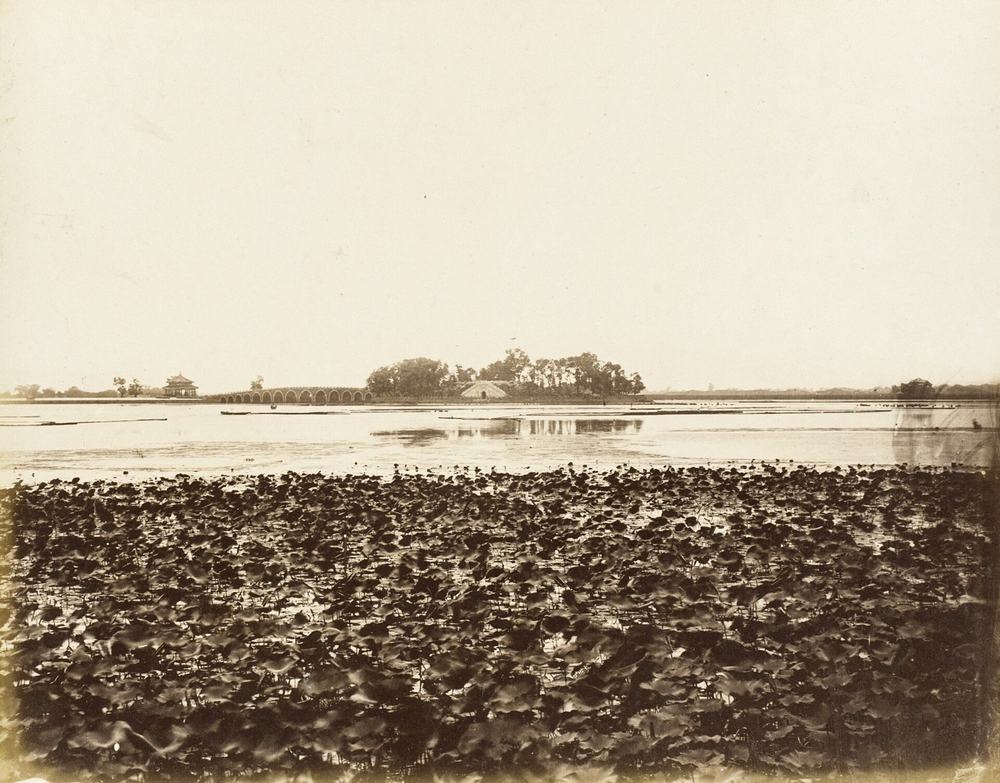
清漪园 Qingyi Yuan, about 2 li to the west (S05), was laid out from 1750 round the enlarged lake 昆明湖 Kunming Hu and the hill renamed 万寿山. In 1860 it had no wall round its lake (S02 p.199). 静明园 Jingming Yuan held the hill of the Jade Spring, the source of the gardens' water, with its pagoda 玉峰塔; 静宜园 Jingyi Yuan lay further out on 香山 in the Western Hills.
South of our gardens, Kangxi's 畅春园 Changchun Yuan, inside a wall of 1,060 丈 (about 3.4 km, S05 j76), had decayed by the Daoguang reign; 西花园 lay to its west. Round them stood smaller gardens granted to princes and officials: 蔚秀园 (held by 奕譞 from 1858), 朗润园 (奕䜣), 淑春园, 鸣鹤园 (绵愉), 镜春园, 承泽园, 熙春园 and 近春园, and the houses of officials on duty at the court, 集贤院 and 澄怀园, the garden of the Hanlin academicians.
In the 3D view these gardens are massing only: an outline, a wall where one is recorded, a few blocks. Their outlines come from today's campuses and parks or are circles round a point, and are marked as guesses.
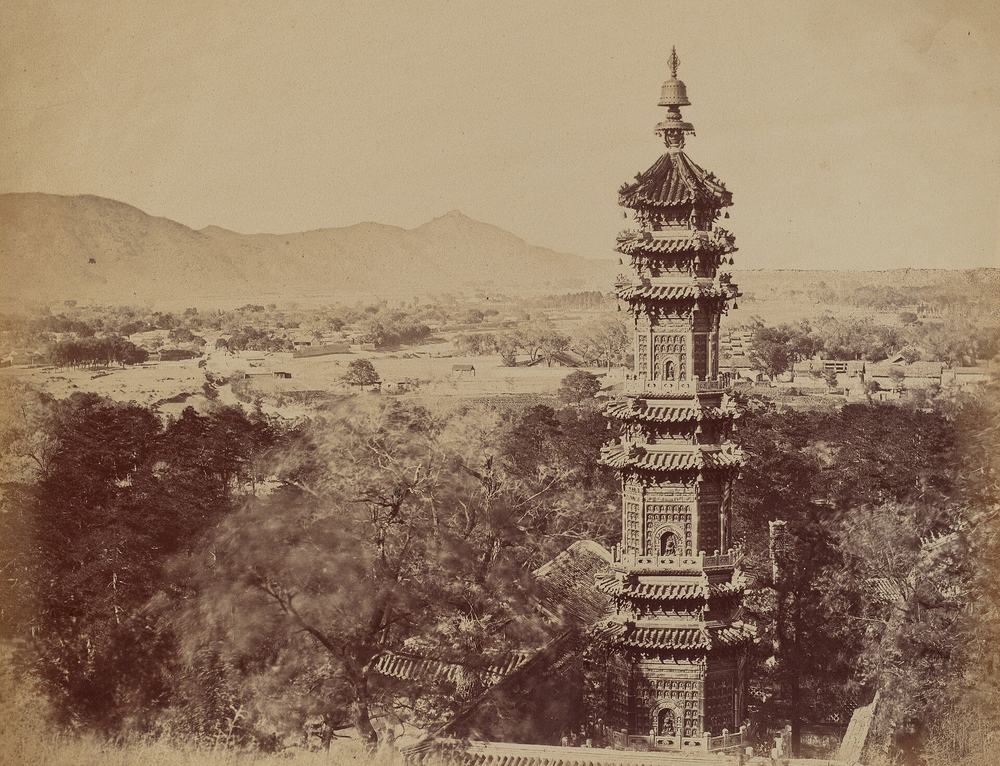
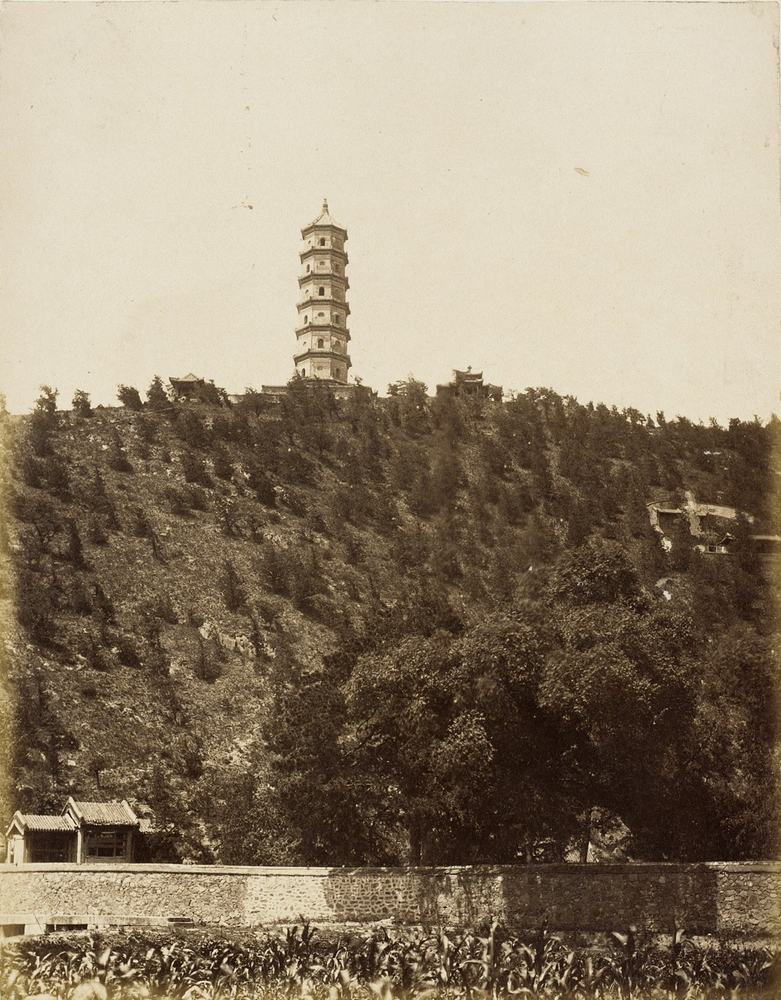
The water
The gardens' lakes were fed from the west. Water from 玉泉山 ran to 昆明湖, and from 1764 a sluice, the 二龙闸, let it east; the springs of 万泉庄 sent the 万泉河 north past 畅春园. The two met at the horse grounds 马厂 and entered Yuanming Yuan by a sluice of one opening east of 藻园门 in the south-west, the 一空进水闸 (S05 j80; S348). The water ran through the gardens to the east and left by the 七孔闸 for the 清河 in the north (S05 j80, j83). From the south tip of 昆明湖 the 长河 carried the court's boats to the city.
The canals in the view follow today's channels where they survive and are drawn as bands of water; the inflow canal meets the garden at its sluice. Their widths are guesses.
The road from the city and the town of Haidian
A stone-paved road ran some 20 li from 西直门 to the gardens (S05 j98), paved before 1721 and repaired in 1724; a Korean envoy in 1790 found it about three bays wide. It passed through 海淀 Haidian, the market town where officials serving at the court lodged, and its last stretch ran on a causeway between the two Fan Lakes 扇面湖, dug in 1763, to the main gate. Other roads ran west past 清漪园 to 青龙桥 and the hills.
In the view the roads are bands on the ground along today's roads where those follow the old line (C); Haidian is a block of generated houses inside the built-up area of the 1944 map.
The guard, the offices and the camps
From 1724 the garden was guarded by the 圆明园八旗护军营, one camp for each of the eight banners, set round the garden at a distance, each of 1,250 rooms (间), 1,550 after 1747, and a camp of 504 rooms for the three bondservant banners (S1237). The camps' places survive as village names today: 正白旗, 镶黄旗, 正黄旗, 正红旗, 镶红旗, 镶白旗, 正蓝旗 and 三旗. Their headquarters stood beside the 红桥 canal. An eyewitness of October 1860 saw a camp as low houses inside a wall eight feet high with a wooden gate (S241).
No plan of a camp is known. The view draws each as rows of low houses in a walled rectangle sized from its count of rooms; the rows, the walls and the houses are all guesses.
Villages, temples and fields
Qing texts name the villages of the plain, 挂甲屯, 成府, 树村, 萧家河, 大有庄, 青龙桥, 六郎庄 and others, each with its small temples (S05 j99-100). Rice was grown between 昆明湖 and Haidian and east of the gardens; a French plan of 1864 writes 'rizières' there (S22), and the 1944 map still shows paddy (S20). The rest of the plain was dry farmland.
Villages appear as clusters of generated houses round today's village names; their sizes are not recorded.
October 1860
The destruction came through this ring. On 6 October 1860 French troops with British cavalry came from the north of the city, through Haidian on the paved road and between the two lakes to the main gate; the cavalry went round the town to the east (S241, S245). The looting of the gardens began that day. On 18 and 19 October British troops under Sir John Michel, on Elgin's order, burned 圆明园 and the other palaces of the area: 清漪园, 静明园 and 静宜园, and outside our walls 恩佑寺, 恩慕寺, the review tower 阅武楼 and buildings of 澄怀园 (S02 pp.187-189; S1207, quoting the memorial of 明善). The French refused to take part.
How sure the setting is
138 objects in the layer: 77 shown on a source of the time (A), 42 from a later source or a text only (B), 19 inferred (C); 55 placed by a guess.
villages 27, temples 20, neighbouring gardens 15, banner camps 11, canals 8, bridges 7, sluices 7, roads 6, paddies 4, storehouses and yards 4, offices 3, hills 2, lakes 2, rivers 1, springs 1, town 1
Unknown: the outline of any camp, village or princely garden; the width of any road; where three of the eastern sluices stood; which village burned in the night of 7-8 October 1860. The ground beyond the walls is the plain of the inner ground extended, with the hills from today's elevation model, which includes today's trees and the rebuilding of the 1880s. The questions are listed in the project's research notes (Q264-Q280).
Sources cited on this page (11)
- S01 Plan of the Yuanmingyuan Imperial Garden-Palace, unknown artist, three hanging scrolls, ink and colour on paper, 177 × 253 cm together
- S02 Carroll Brown Malone, History of the Peking Summer Palaces under the Ch'ing Dynasty, Illinois Studies in the Social Sciences XIX, Urbana 1934; reprint Paragon 1966
- S05 《日下旧闻考》 Rixia jiuwen kao (Yu Minzhong et al.), juan 80-85 (Round 20 also juan 76-79, 84-87 and 98-100: the gardens round ours, the roads, 郊坰), Kanripo KR2k0036, WYG base
- S20 GSGS 3789 / AMS Eastern China 1:50,000, Peking, sheet 16/2200, 3rd ed
- S22 Plan des environs du Palais d'été, after Capt
- S241 Robert Swinhoe, Narrative of the North China Campaign of 1860, London: Smith, Elder, 1861
- S245 Paul Varin, Expédition de Chine, Paris: Michel Lévy, 1862
- S348 贾贯峰 (圆明园博物馆), 圆明三园进出水口探析, 中国园林 2024, 40(4): 129-133, DOI 10.19775/j.cla.2024.04.0129
- S1207 赵连稳, 1860年:英法联军只焚烧了圆明园吗? 前线 2019 no.11, on 澎湃 2019-11-15; quotes the memorials of 明善 (圆明园内外被抢被焚情形折), 奕訢 et al
- S1217 北京大学政策法规研究室, 文物保护 pages: 淑春园 (6bazys386), 翼然亭 (6bazys406)
- S1237 《钦定八旗通志》(四库全书本) 卷116 营建志五 八旗驻防规制一 京都驻防 (圆明园八旗驻防, 包衣三旗驻防, the camps' places; 健锐营; 火器营)